Marriage Records in Kane County can be retrieved in minutes through the online marriage record lookup tool, giving you instant access to certified copies and informational extracts. Whether you need a marriage certificate for legal purposes or a genealogical clue, the clerk’s database lets you search by name, date, or record number. Quick verification of spouse details and marriage dates helps avoid common delays and ensures you receive the correct document.
Marriage Records also include archived and historical files that support family history research and genealogy projects. Kane County’s recorded marriages and digitized indexes let you trace older unions, while amended records correct clerical errors or wrong dates. Certified marriage certificate requests and informational copies follow a straightforward submission, and the office provides authentication to confirm record numbers and name variations. Understanding these options reduces frustration when a record seems missing or mismatched.
How to Search Marriage Records
Marriage Records document marriages that came under Kane County’s recordkeeping. In addition, consulting official kane county records confirms that a search can locate an entry by the couple’s names, marriage date, or record number, then show whether the source is a current record, index, archive, or amendment. The main purpose is to identify the correct entry before requesting a paper copy or using it for family research. Coverage varies by record age, so an empty result does not always mean the marriage was never recorded.
Official Search Portal: https://clerk.kanecountyil.gov/VitalRecords/Pages/Marriage.aspx
Steps to Search
- Open the Kane County Clerk marriage-records page and follow its marriage-record search or request link.
- Enter the couple’s surnames, given names, marriage date, or record number. Start with one surname and a broad date range if the exact details are uncertain.
- Review each result and compare the spouses’ names, ceremony date, recording date, location, and record number.
- Check the source shown with the result. A current record, historical index, archived entry, and amended record each require a different next step.
- Follow the county’s instructions for obtaining a plain copy or certified marriage certificate. Confirm the current fee, required payment method, and delivery method before submitting the request.
Types of Marriage Records
Marriage records can describe several different stages of a marriage transaction. Knowing which type you have prevents a license search from being confused with a record of the ceremony, or an index entry from being treated as a certified document.
Recorded Marriage Records
A marriage enters the county record when the completed license is returned after the ceremony. The recorded entry may include the spouses’ names, ceremony date, recording date, ceremony location, officiant, and a source reference such as a book, page, or file number. A marriage license serves a different purpose because it shows permission to marry, not proof that the ceremony took place.
Marriage Record Indexes
A marriage index organizes entries under names and dates so researchers can locate source records. Some indexes list a license application, license issue date, ceremony date, or recording date in separate fields. A date appearing in an index may not be the date of the ceremony. Index cards can also contain spelling mistakes, omitted names, or source references that differ from the original record.
Historical Marriage Records
Older marriages may be represented by a handwritten register, typed ledger, microfilm image, card index, or early database entry. The Kane County Clerk’s current collection does not have to cover every year in the same way. The Illinois State Archives maintains historical marriage indexes that may point to entries from earlier periods, but an index result remains separate from a certified copy of the source record.
Amended Marriage Records
An amended marriage record is the official version after a confirmed error has been addressed. It can differ from the first entry in a spouse’s name, a date, an omitted detail, or another field changed through the correction process. An amendment does not make every index or previously issued copy accurate by itself, so researchers should note the date of the amended record they used.
Archived Marriage Records
Archived records include older books, certificates, index cards, microfilm, and digitized images kept for long-term research. The archive may hold the source record without offering a current certified-copy service. A researcher may need to cite the archive’s collection title, book or box number, and page or image number when a family history source does not appear in the current database.
Certified Marriage Records
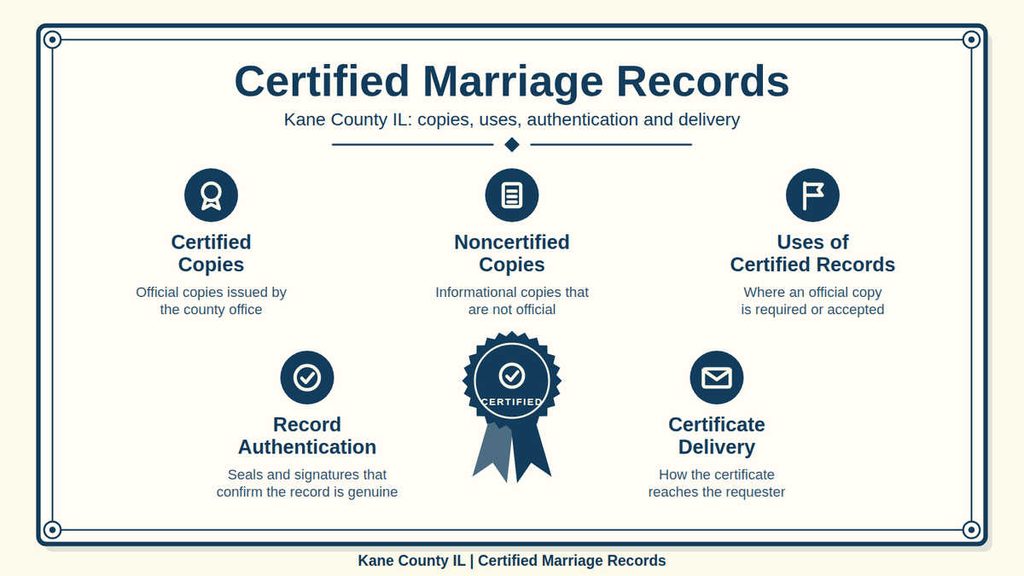
A certified marriage certificate is an official copy issued with the clerk’s authentication. Many recipients ask for this version because they need more than a search result or plain copy. Certification can include a seal, signature, certification statement, or another form of authentication named by the issuing office. The record itself must still be checked against the couple’s names, date, and source details.
Certified Copies
Choose a certified copy when the receiving agency requires proof issued by the custodian of the record. A screen image, index listing, family tree entry, or plain extract may help during research, but it may not satisfy a request for a certified marriage certificate. The Kane County Clerk determines the form of authentication placed on the certified copy.
Noncertified Copies
A noncertified copy serves as a working record for research. It may reproduce the same core names and dates as the official entry without proving that the county issued the copy. Use it to compare results, build a family timeline, or locate a record number before paying for certification. If two plain copies differ, compare the original source rather than deciding which version is correct by appearance alone.
Uses of Certified Records
Certified marriage certificates commonly appear in immigration files, passport applications, estate proceedings, insurance claims, property matters, and legal cases. The requesting agency may set rules about issue date, seal, signature, or the number of copies needed. Send the recipient’s exact document requirements to the clerk with the request so the correct copy can be produced.
Record Authentication
Authentication and content accuracy are separate checks. A document may carry the clerk’s seal yet contain a name that you believe is wrong, or it may show the right names but lack the required certification. Review the seal or signature, certification wording, record number, spouse names, date, and county before accepting the document for its stated purpose. The clerk can confirm whether a questioned copy was issued by that office.
Certificate Delivery
Marriage record requests may be made through the county’s online request process, by written mail request, or in person at the clerk’s office. A complete request should identify the couple, date, county, record number when known, copy type, and return method. If several records fit the same names, add details that separate them, such as the ceremony location or recording year.
Confirm the current fee and expected processing time when submitting the request. Copy charges can change, postal delivery adds time outside the clerk’s control, and a search result does not mean a certified certificate has already been issued. Keep the confirmation message, receipt, or file number so the status of a mailed or online request can be followed.
Historical Marriage Records and Genealogy
Genealogy work often begins with an imperfect index and ends with the source marriage entry. The Kane County Clerk’s current records and the Illinois State Archives’ historical indexes serve different research stages. A sound family history method records what each source says, compares dates and names, and cites the collection used.
Older Marriage Records
Records from earlier decades may appear in bound registers, loose certificates, card indexes, microfilm, or scanned images. The earliest surviving collection may also begin after the couple’s marriage. A search of the current county portal should still be followed by a check of the older holdings named on the official page. The Illinois State Archives may hold an index that points to a source entry without providing a current Kane County certified copy.
Marriage Indexes for Genealogy
An index compresses several facts into a short entry. It may name one spouse more fully than the other, place both under one surname, or use an initial instead of a given name. Dates can refer to the license, ceremony, or filing. Researchers should compare the index with nearby pages, the couple’s residence, the officiant, and church or civil records before accepting an indexed date.
Archived Record Collections
An archive may preserve the original book without creating a separate search result for every marriage. Its catalog can describe a volume by date range, surname sequence, or file series. A family tree can cite that volume and page, yet a certified copy may still need to come from the office named as the current custodian. This distinction prevents an archival reference from being mistaken for a newly issued certified document.
Digitized Records
Digitized records can make handwritten or typed source pages easier to read, but the index may have been created by a different person. Look for faded writing, abbreviations, overwritten names, and shifted date entries. Save the page citation with the family tree note. A digital image confirms what appears on that page, but it does not replace a certified copy when the receiving agency demands one.
Family History Research
A family history search becomes more reliable when each result is tested instead of accepted on the first match. Use the following checks when a marriage entry falls outside the current database or contains a disputed detail:
- Search by one spouse’s surname and given name, then repeat with the other spouse.
- Try spelling variants, initials, shortened names, and pre-marriage surnames.
- Widen the date range and compare license, ceremony, and recording dates separately.
- Check the county that issued the license when the ceremony took place elsewhere.
- Record the source citation, page or image number, and any later correction.
- Order a certified copy before relying on a disputed entry for a legal purpose.
Marriage Record Corrections
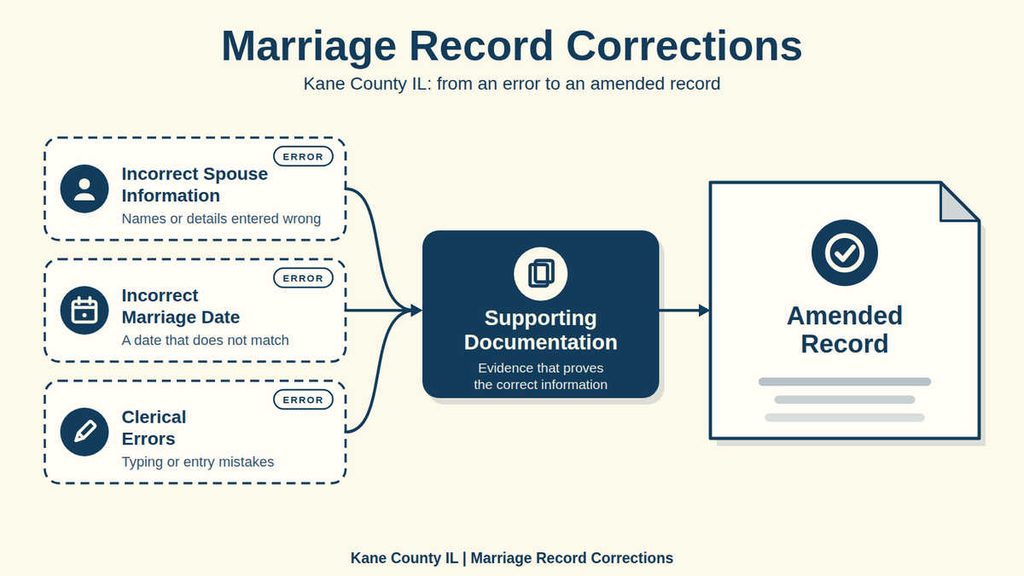
A suspected error can sit in three places: the search index, the source document, or a transcription made for a database. A spelling mistake in an index does not prove that the official record is wrong. Start by comparing the index with the source image or certified copy, then ask the Kane County Clerk which correction path applies to the entry you found.
Incorrect Spouse Information
A name error may involve a misspelled surname, wrong given name, omitted prefix, or the use of a later surname in the index. In addition, consulting official marriage license records confirms that it can also involve the wrong person when two couples shared a surname and marriage year. Compare the full names, marriage date, location, and source number. If one spouse legally changed a name before the marriage, include proof of that change with a correction request rather than relying on a new surname alone.
Incorrect Marriage Date
Date errors often begin with mixed date types. The license may have been issued on one day, the ceremony held on another, and the completed license recorded later. Ask which date the disputed entry contains, then compare each date with the license, certificate, or source register. The requested correction should name the exact field and the date supported by the source.
Clerical Errors
Clerical errors can include an omitted character, copied digit, misspelled place name, incorrect first name, or entry filed under the wrong heading. Some errors affect only a finding aid and can be corrected without changing the legal record. Others require a formal amendment. A written description of the error, the correct value, and the location of the source record gives the clerk a clear basis for review.
Supporting Documentation
The clerk decides which evidence is required for a particular correction. A requester may be asked for one or more of the following items:
- The marriage license application or a copy of the completed license.
- The recorded certificate, register page, or archive image containing the disputed entry.
- Proof of a legal name change when the record uses an outdated surname.
- A written explanation that identifies the incorrect field and the corrected value.
- Identification, authorization, or payment required by the clerk’s correction process.
Amended Record
An amended record is created only after the correction has been approved through the proper process. The amended copy may note that it supersedes an earlier version. A previously issued certified copy does not automatically show the later change, so people who need the corrected version should request a new copy after the amendment is recorded. Families using both versions in their research should cite the amendment date and the field that changed.
Accuracy and Verification
Accuracy checking means comparing more than one field within the same source and across available sources. Names, dates, locations, and record numbers should point to the same marriage. If they do not, identify the conflict before treating the result as proof of identity, family structure, or a legal event.
Confirming Spouse Identity
Compare each spouse’s full name with the source rather than relying on a familiar surname. Check given names, middle names, prefixes, and the order in which the names appear. A search result may combine index cards created years apart. The correct couple should share the same event details, such as a compatible date, location, and source reference.
Verifying the Marriage Date
Label every date shown in a result. A license date, ceremony date, and recording date answer different questions. If the portal displays only one date, compare it with the certified copy or source image before placing it on a timeline. For family history, record the date type in the source note so later researchers do not mistake one event for another.
Checking Record Numbers
A record number is the cleanest way to distinguish matching names when the portal supplies one. Keep it with the couple’s names, date, and source reference. Do not assume that two results with separate numbers represent duplicate marriages; they may involve different couples or different record books. Use the number when ordering a copy or discussing an error with the clerk.
Name Variations
Genealogical records can contain abbreviated names, initials, transliterations, nicknames, and spelling changes. A search for one exact surname may miss an entry filed under a variant. Try the other spouse’s surname, a broader given name, and common spelling forms. Once a candidate appears, judge the match against the event details rather than the surname alone.
Index Errors
An index error is a mistake in the finding aid, not proof of a mistake in the marriage itself. Signs include a reversed date, omitted character, copied surname, or a source number that does not match the book. Report the exact index entry and the conflicting source value. The clerk can then decide whether the finding aid needs correction or the legal record needs an amendment.
Official Record Verification
Official verification requires tracing the result back to the record custodian. Confirm the county that issued the marriage license, the names of both spouses, the ceremony date, the recording date, and the record or source number. If the online result does not show enough to make that comparison, request the source page or a certified copy. For disputed facts, ask the clerk to review the original record and state what supports the answer.
Marriage Record Search Problems
A failed search often reflects a narrow search term, mixed date types, or a record outside the current online collection. Work through one problem at a time and record each query used. This creates a clear trail for family history research and helps the clerk locate a specific entry if the initial search does not succeed.
Record Not Found
Begin with the least restrictive search supported by the portal. Search one surname, one given name, and a broad year range before adding exact dates. A blank page can also mean that the record sits in an older collection outside the current database. Keep the unsuccessful terms, then move to the historical holdings rather than repeating nearly identical searches.
Name Does Not Match
Do not rule out a match because one surname differs. A woman may appear under a pre-marriage name, a later surname, an initial, or a spelling used by the family. Search each spouse separately and remove punctuation from the name fields. Compare the result’s location, date, and source number with other facts about the couple.
Wrong Marriage Date
Widen the search around each type of date shown on a license or certificate. The couple may have received the license weeks before the ceremony, and the county may have recorded the completed license later. If the portal uses a year-only filter, nearby years may contain the correct entry. A date conflict should be noted rather than silently changed on a family tree.
Wrong County
Search the county that issued the marriage license, not only the county where the ceremony occurred. Illinois couples can receive a license in one county and marry in another, so residence and ceremony location may also differ. A marriage record normally returns to the issuing clerk after the ceremony. This jurisdiction detail can prevent a valid Kane County search from being routed elsewhere.
Historical Record Not Digitized
Older entries can exist without an online image. The Kane County Clerk’s page and the Illinois State Archives’ historical indexes can provide leads into registers, card files, and archived volumes. Cite the source you actually viewed. If the item remains outside the current portal, request assistance from the custodian and give the couple’s names, date range, and any known source reference.
Restricted Record
Public copy service and public viewing of every source document are not the same thing. Some license files or fields may have release rules set by state law or office policy. Ask the clerk which part is restricted, the legal reason, the items needed for review, and whether another copy form is available. Do not assume that a missing online field means the field was absent from the original record.
Delayed Record Availability
A marriage may take time to move through license return, recording, indexing, and digitization. An event can also remain outside an online collection for years. Confirm that the completed license was returned and that the portal covers the expected year. For a copy request, keep the confirmation number and ask for its status. Avoid promising a fixed date for a record that has not yet reached the recording stage.
Contact Information
Marriage record requests and marriage license questions can be directed to the Kane County Clerk using the contact details below. The Clerk’s office maintains marriage records and provides information about applicable request procedures. Requesters should confirm record availability, eligibility requirements, fees, and accepted identification before submitting an application. The required process may vary depending on the record date and type of request. Contacting the Clerk directly can help clarify the latest requirements and processing details.
Frequently Asked Questions
Marriage records in Kane County give proof of a legal union. They help people verify dates, locate ancestors, and obtain certified copies for legal or personal reasons. The clerk’s office offers online lookup, in‑person assistance, and mail requests. Knowing how to search, request, and correct these records saves time and avoids extra fees.
How can I search Kane County marriage records online?
Visit the Kane County Clerk website and select the marriage record search link. Enter the spouses’ full names, marriage date, or record number. The system returns the matching entry, shows whether the record is current or archived, and displays the required fee. After confirming the details, you can request a certified copy directly through the portal.
What information appears on a Kane County marriage certificate?
The certificate lists the bride and groom’s full names, birth dates, and residences, the marriage date, location of the ceremony, and the officiant’s name. It also shows the record number and the clerk’s seal. This data is used for name changes, immigration paperwork, and genealogy research.
Can I request a certified copy of a Kane County marriage record by mail?
Yes. Complete the mail‑in request form, attach a copy of your photo ID, and include the required payment (check or money order). Send everything to the Kane County Clerk’s office at 719 S. Batavia Ave., Building B, Geneva, IL 60134. Processing usually takes 7‑10 business days, and the certified copy is mailed to the address you provide.
How do I correct an error on a Kane County marriage record?
First, gather proof of the correct information, such as birth certificates or a previous marriage license. Contact the clerk’s office by phone or in person, explain the mistake, and submit a correction request form with the supporting documents. The clerk reviews the request, updates the record, and issues an amended certificate, often within two weeks.
What are the fees for obtaining a Kane County marriage record?
Standard fees are $5 for an index lookup, $10 for a basic copy, and $15 for a certified copy with a raised seal. Requests for expedited service add $5. If you need a historical copy (older than 100 years), the fee may rise to $20. All payments must be made by check, money order, or credit card if ordered online.